

Consolidated billing is the practice of combining charges from multiple products, benefit lines, or even carriers onto a single invoice for an employer group or member. For health plans managing multiple lines of business, carrier relationships, and product combinations, it eliminates the operational burden of generating, tracking, and reconciling separate bills for each coverage type.
The concept sounds straightforward. In practice, it is one of the most complex billing challenges in health insurance. Each entity or product has different rate structures, payment timelines, and remittance requirements that must be preserved even when charges appear on one invoice.
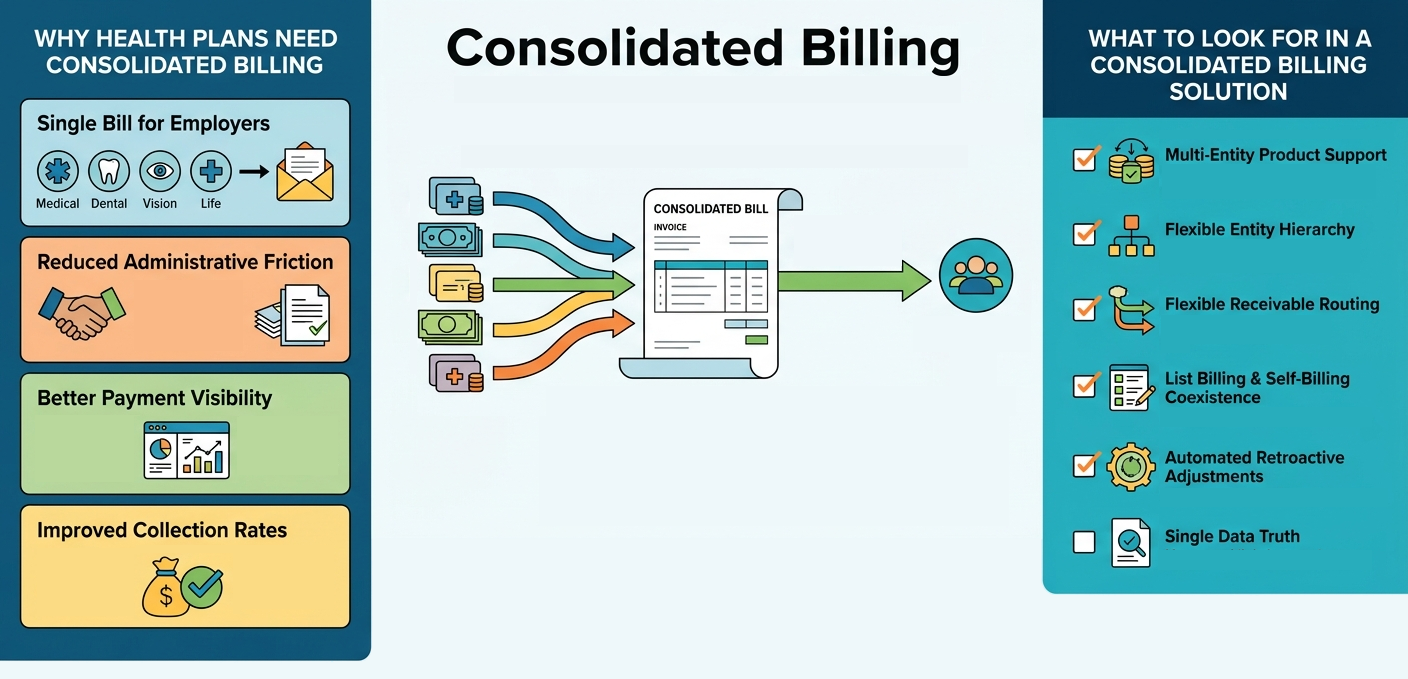
Why health plans need consolidated billing
Employer groups expect a single bill. When a benefits program includes medical, dental, vision, life, disability, and supplemental products, sending separate invoices for each creates confusion, delays payment, and increases administrative costs for everyone involved.
Health plans that offer consolidated billing reduce friction for their employer group clients. They also gain better visibility into payment status across all products, reduce inbound billing inquiries, and improve collection rates by making it easier for groups to pay accurately and on time.
Without consolidation, billing teams spend hours manually aggregating charges, cross-referencing enrollment data, and chasing discrepancies between what was billed and what was received.
How consolidated billing works in a purpose-built platform
A purpose-built premium billing platform approaches consolidation differently than a general ledger or ERP system bolted onto an enrollment or claims management platform. Rather than ingesting and reconciling carrier bills after the fact, it ingests carrier rates, billing rules, and enrollment data to generate financial transactions itself, serving as the single source of financial truth.
This means the billing system does not depend on receiving accurate invoices from carriers to produce accurate bills. It calculates what is owed based on enrollment and rate configurations, then generates invoices that consolidate products from any combination of entities onto a single statement.
Certifi’s William™ platform, built on Perfect Balance™ architecture, supports this approach. Clients include private exchanges with fully-insured products from 80+ different carriers offered to one set of group clients. The platform handles average client sizes of 50,000+ lives with typically five to seven carriers on a single consolidated bill.
The employer group hierarchy that makes it possible
Consolidated billing requires a flexible entity structure. A rigid one-size-fits-all hierarchy cannot accommodate the variety of ways employer groups organize their populations.
An effective approach uses a multi-level hierarchy to enable multiple levels of consolidation. Individual companies can be established as “Sites” under a “Sponsor” that receives the consolidated invoice. Charges can contain multiple receivable components, each routed to separate invoices or entities as needed.
This means a single employer group can receive one consolidated invoice while the billing system segments the underlying charges for remittance to each carrier. The billing system handles the complexity; the employer group sees simplicity.
Self-billing and list billing coexistence
Plans that sell voluntary products may need to support both list billing (where the plan generates the invoice) and self-billing (where the employer reports its enrollment volume) for different groups, or even for the same individuals across different products.
A consolidated billing platform supports both formats simultaneously. An individual can appear on a group list bill for core medical coverage while also receiving an individual direct bill for other products, all without duplicating member records or creating reconciliation problems.
Self-administered billing lets an employer enter headcount, volume, and adjusted rate amounts to calculate what is due. Defaults carry forward from the prior month, and retroactive credit or debit adjustments to prior periods are fully supported within the consolidated framework.
What to look for in a consolidated billing solution
When evaluating billing platforms for consolidated billing capability, health plans should confirm:
- Support for products from multiple legal entities on a single invoice
- Flexible entity hierarchy that matches real-world employer group structures
- Ability to route receivable components to different invoices or entities
- Coexistence of list billing and self-billing without data duplication
- Automated retroactive adjustment processing across all consolidated products
- Single source of data truth that reduces reconciliation
The Certifi team has built seven billing platforms over the past 30 years, and consolidated multi-carrier billing has been central to each generation. Certifi’s William platform handles the full complexity of consolidated billing for some of the largest public and private exchanges in the United States.
Frequently asked questions
What is the difference between consolidated billing and combined billing?
Many use the terms interchangeably. In practice, consolidated billing typically refers to combining charges from multiple product lines or carriers onto a single invoice, while combined billing may refer to grouping multiple members or coverage tiers on one statement. A purpose-built platform supports both.
Can consolidated billing handle retroactive adjustments?
Yes. When enrollment changes occur retroactively, a properly designed consolidated billing platform automatically recalculates affected charges and applies credits or debits to the appropriate consolidated invoice without manual intervention.
Does consolidated billing work for both fully-insured and self-funded groups?
Yes. The billing platform generates charges based on rate rules and enrollment data regardless of funding arrangement. Both fully-insured carrier products and self-funded administrative fees can appear on the same consolidated invoice.
Learn how Certifi eliminates billing complexity. Request a demo.
Related Resources
- Premium Billing Features & Capabilities
- What Software Supports Premium Billing for Both Individual and Group Health Plans?
- 4 Benefits of Accounting Architecture in Premium Billing Software