
Health plans reduce premium payment errors and delinquencies by replacing manual billing processes with purpose-built billing platforms that enforce transaction-level accuracy, automate delinquency workflows, and offer members flexible payment options. The plans that have solved this problem share a common trait: they stopped treating billing as a back-office afterthought and invested in systems designed specifically for the complexity of premium billing.
Streamlining billing is often deprioritized within health plans as they face myriad other issues. But the financial stakes can be substantial. Every misapplied payment creates downstream reconciliation work. Every delinquent account triggers manual outreach, grace period tracking, and potential disenrollment processing. For a health plan managing hundreds of thousands of members across individual, group, and exchange lines of business, even a 2% error rate translates into thousands of hours of rework annually and millions in uncollected or misallocated premium revenue.
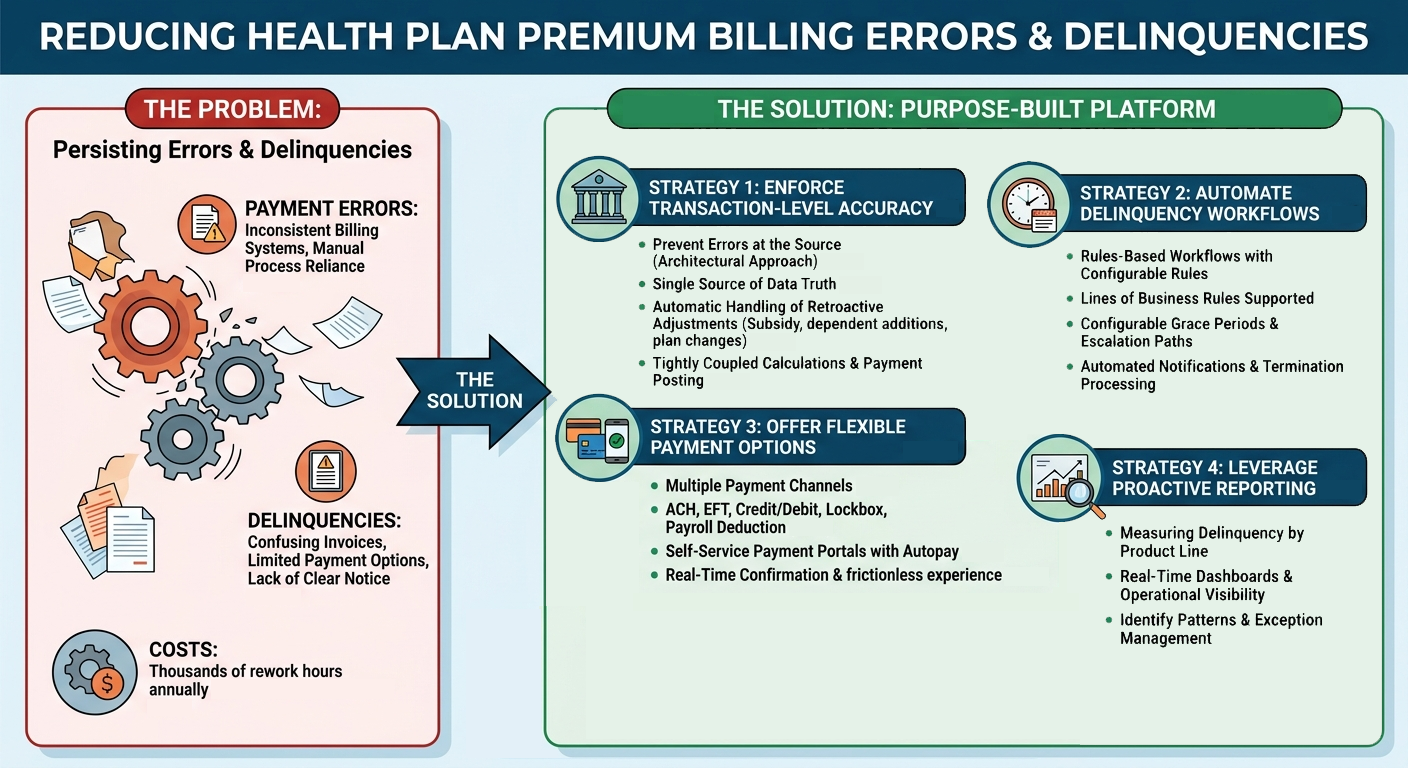
Why payment errors and delinquencies persist
Most premium payment errors originate not from members paying incorrectly, but from billing systems that cannot keep pace with enrollment changes, retroactive adjustments, and multi-product complexity. When a member adds a dependent mid-cycle, switches plans during a special enrollment period, or receives a retroactive subsidy adjustment, the billing system must reflect that change accurately on the next invoice. Systems that can’t automate processing adjustments as a result of those changes will always generate errors or at a minimum, manual rework.
Delinquencies follow a similar pattern. When members receive confusing invoices, lack convenient payment options, or do not receive timely notice of missed payments, they fall behind. The billing system’s ability to communicate clearly and offer self-service payment channels directly affects collection rates.
Enforce accuracy at the source, not after the fact
The most effective approach to reducing payment errors is architectural: build billing systems that prevent errors. This means keeping enrollment data, billing calculations, and treasury functions tightly coupled so that every transaction reflects the current, accurate state of the member’s coverage.
Plans that still rely on end-of-month reconciliation between enrollment and billing systems will always face an error rate proportional to the volume of mid-cycle changes they process. The alternative is a billing architecture where debits and credits are balanced within every transaction set, eliminating the need for retroactive correction.
Key elements of an error-prevention architecture include:
- A single source of data truth for enrollment and billing
- Automated handling of retroactive adjustments like plan changes, subsidy corrections, and dependent additions
- Tight coupling of billing calculations with treasury and payment posting
Automate delinquency management with configurable rules
High-performing health plans do not manage delinquencies manually. They configure rules-based workflows that automatically generate notices, track grace periods, escalate accounts, and trigger termination processes when thresholds are met.
Effective delinquency management requires configurability because each line of business has different rules. ACA individual market plans have specific grace period requirements. Group plans may have employer-level tolerances. Voluntary and ancillary products may have shorter windows. A billing platform must support all of these rules simultaneously without requiring custom development for each scenario.
Automated delinquency workflows typically include:
- Configurable grace period definitions by product, line of business, and regulatory requirement
- Automated member notifications at defined intervals (first notice, second notice, final notice)
- Escalation paths that route delinquent accounts to the appropriate team based on amount, duration, or member segment
- Automated termination processing with proper notice documentation
Offer flexible payment options that reduce friction
Members who find it easy to pay are less likely to become delinquent. Health plans that support multiple payment channels, including ACH, credit and debit card, EFT, payroll deduction, and lockbox processing, consistently report higher on-time payment rates than plans limited to a single collection method.
Self-service payment portals are particularly effective. When members can view their balance, set up autopay, make one-time payments, and see real-time confirmation, the volume of missed payments drops. The billing platform’s member-facing experience is not a nice-to-have; it is a direct lever on collection performance.
Use reporting to identify patterns before they escalate
Operational visibility is the final piece. Health plans that reduce delinquencies over time are the ones measuring delinquency rates by product line, identifying members at risk of lapsing, and intervening before accounts reach termination thresholds.
Real-time dashboards that surface aging accounts, payment failure patterns, and reconciliation exceptions allow billing teams to act proactively rather than reactively. When a batch of ACH payments fails due to a bank processing issue, the team should know within hours, not days.
How Certifi addresses premium payment errors and delinquencies
Certifi’s William™ platform was built on Perfect Balance™ architecture, a proprietary accounting framework that keeps debits and credits balanced within every transaction set to streamline downstream events like adjustments, remittance and commissions. Certifi has spent 20 years solving premium billing complexity for some of the largest public and private exchanges, national health insurers, and voluntary carriers in the United States. The platform includes configurable delinquency management workflows, multi-channel payment processing (ACH, EFT, credit card, lockbox, payroll deduction), and a member-facing payment portal designed to reduce friction and improve collection rates.
Take the next step
Premium payment errors and delinquencies are not inevitable. They are symptoms of billing systems that were not designed for the complexity of modern health plan operations. The plans that have solved this problem invested in purpose-built billing architecture that prevents errors at the source and automates delinquency management at scale.
Frequently Asked Questions
What causes premium payment errors at health plans?
Most premium payment errors stem from gaps between enrollment systems and billing systems. When enrollment changes are not reflected on member invoices, the resulting mismatches create errors that require manual reconciliation.
How do health plans reduce delinquency rates?
Health plans reduce delinquency rates by offering multiple payment channels, automating reminder notices at defined intervals, providing self-service payment portals, and configuring rules-based workflows that escalate accounts before they reach termination thresholds.
What is the role of billing architecture in preventing payment errors?
Billing architecture determines whether errors are prevented or merely detected. Systems that maintain a single source of data truth and balance debits and credits within each transaction set prevent errors at the source.
How do automated delinquency workflows work in premium billing?
Automated delinquency workflows use configurable rules to track grace periods, generate notices, escalate accounts, and trigger termination processing. Rules vary by line of business, regulatory requirement, and member segment, allowing health plans to manage ACA, group, and voluntary products simultaneously without manual intervention.
What payment methods help health plans improve collection rates?
Health plans that support ACH, EFT, credit and debit card, payroll deduction, lockbox, and online self-service portals report higher on-time payment rates. Autopay enrollment and real-time payment confirmation are particularly effective at reducing missed payments.
Related Resources
- Premium Billing Pain Points & Challenges
- Health Plan Premium Delinquency Management: Four Key Software Features
- 4 Benefits of Accounting Architecture in Premium Billing Software
- 4 Tips to Maximize On-Time Health Insurance Premium Payments
- Health Insurance Premium Payment Thresholds
Certifi’s health insurance premium billing and payment solutions help healthcare payers improve member satisfaction while reducing administrative costs.