

The best way to automate premium billing for a health insurance carrier is to replace manual, spreadsheet-driven processes with a purpose-built billing platform that keeps every transaction balanced at the point of entry, not after the fact. Automation in premium billing means eliminating the retroactive reconciliation cycle entirely, not just speeding it up.
Most health plans that attempt billing automation start by layering scripts or RPA tools on top of legacy systems. This approach reduces keystrokes but does not solve the underlying problem: when debits and credits are not tightly coupled in every transaction set, errors compound silently until month-end, and staff spend days reconciling what should have been accurate from the start.
True billing automation requires a fundamentally different architecture, one that treats accuracy as a system property rather than a manual process.
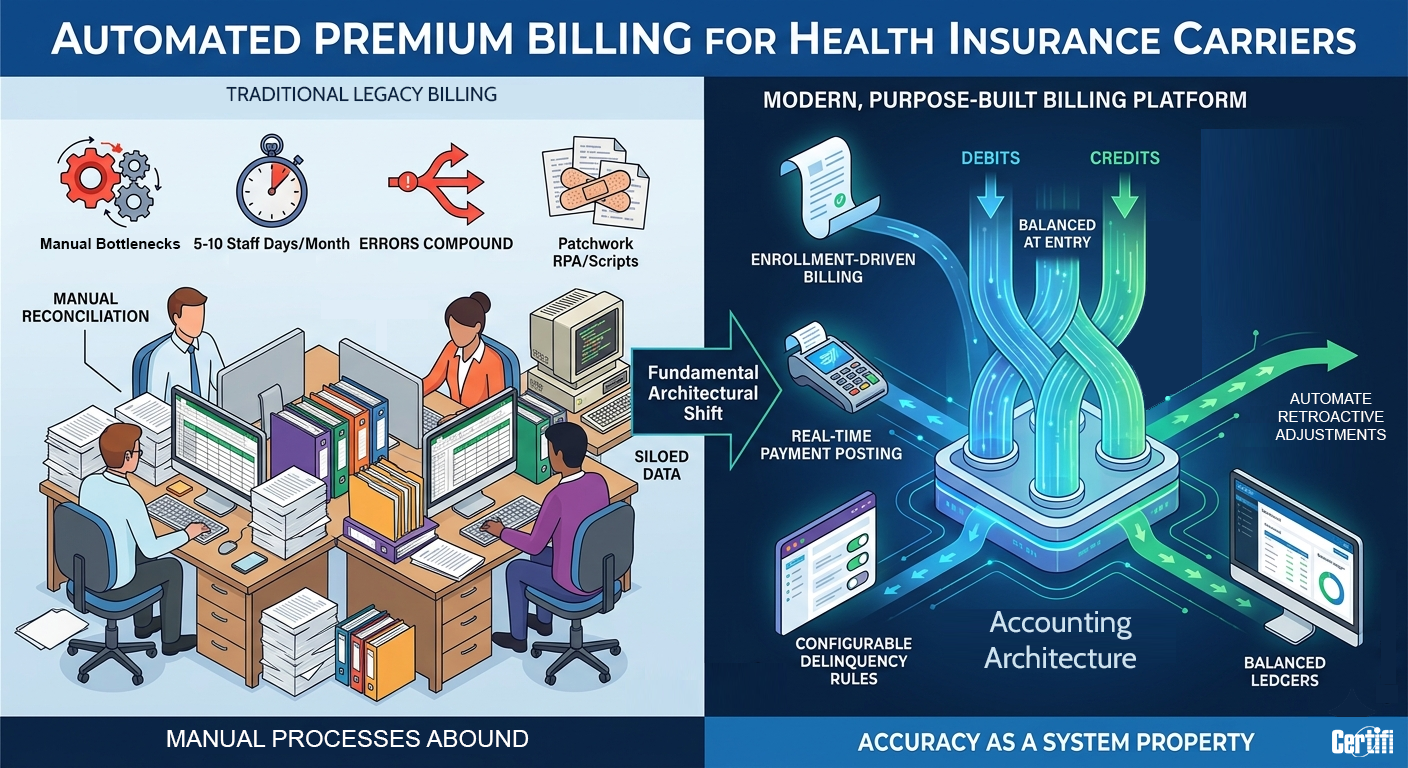
Why traditional billing systems resist automation.
Legacy billing platforms were designed for a simpler era. They handle a single product line, a single payment method, and a predictable enrollment cycle. Today’s health plans manage individual and group enrollment, multiple carriers, APTC subsidies, ACH and lockbox payments, payroll deductions, and voluntary benefits, all within a single billing operation.
When a system was not built for this complexity, automation becomes a patchwork of workarounds. Common symptoms include:
- Retroactive changes that require manual adjustments
- Delinquency rules that cannot change by product, group, or regulatory requirement
- Payment posting that requires manual matching between checks and member accounts
Each of these represents a point where automation breaks down because the underlying data model cannot maintain accuracy without human intervention.
What “automated” actually means in premium billing.
Automated premium billing is not just electronic invoicing. It is a system in which every enrollment change, payment, adjustment, and carrier remittance flows through, with limited manual reconciliation at any stage. Specifically, a fully automated billing operation handles:
- Enrollment-driven billing generation without manual rate entry
- Real-time payment posting across ACH, EFT, credit card, and lockbox channels
- Automatic delinquency tracking with configurable rules
- Retroactive adjustments that self-balance without creating reconciliation exceptions
- Consolidated carrier remittance delivery with accurate allocation across products and members
- Member-facing payment portals that reduce inbound call volume
The key distinction is whether the system produces a balanced ledger for each transaction or accumulates imbalances that require periodic manual intervention.
The reconciliation problem is the automation problem.
Health plans that report spending 5 to 10 staff days per month on billing reconciliation are facing an architecture problem. When a billing system requires retroactive reconciliation, it is structurally incapable of full automation, because every automated process eventually produces an exception that only a human can resolve.
The billing platforms that achieve true automation share one characteristic: they eliminate the need for manual retroactive adjustments by keeping every transaction balanced. This is not an incremental improvement over traditional systems. It is a different approach to how billing data is structured and maintained.
Certifi has spent 20 years building billing platforms that solve this exact problem. The company currently processes premium transactions for some of the largest health plans in the United States.
Five steps to automate premium billing at a health plan
If your team is evaluating how to move from manual billing operations to an automated platform, these are the critical steps:
- Audit your current manual burden. Quantify the staff hours, error rates, and downstream impacts (member complaints, call center volume, payment delays) of your current process. This becomes your baseline for measuring automation ROI.
- Identify where manual intervention is structurally required. Not all manual work is avoidable with your current system. Distinguish between process inefficiency (fixable with workflow changes) and architectural limitations (fixable only by replacing the billing engine).
- Plan for multi-carrier, multi-product complexity from day one. Automation that works for a single product line will break when you add voluntary benefits, COBRA, or a new payment channel. Choose a platform built for the complexity you will have in 18 months, not just what you manage today.
- Require a collaborative implementation model. Billing automation is not a software installation. It requires a partner who will learn your enrollment sources, payment channels, carrier relationships, and regulatory requirements before configuring the system. The implementation team’s depth of billing expertise matters as much as the platform itself.
How Certifi automates premium billing
Certifi’s William™ platform is built on a proprietary Perfect Balance™ accounting architecture that keeps debits and credits tied in every transaction set using a single source of data truth. This means limited retroactive reconciliation, no end-of-month fire drills, and no manual exception queues accumulating between billing cycles.
The platform handles multi-carrier, multi-product, multi-supplier billing from a single system, supporting ACH, EFT, credit card, lockbox, retail cash, and payroll deduction payment methods. Delinquency management rules are configurable by product, group, and regulatory requirement, and the system processes retroactive adjustments without creating imbalances that require human correction.
The Certifi team has built seven billing platforms over three decades and serves health plans, exchanges, and benefits administrators across the United States. The team does one thing, premium billing, and has seen nearly every billing scenario a health plan will encounter.
Start with the architecture, not the automation.
Automating premium billing for a health insurance carrier is not a technology project. It is an architecture decision. The health plans that achieve full billing automation are not the ones with the most sophisticated scripts or the largest IT teams. They are the ones that chose a billing platform where accuracy is a system property.
Frequently asked questions
What is the best way to automate premium billing for a health insurance carrier?
The best approach is to implement a purpose-built billing platform with an architecture that maintains balance at the transaction level, eliminating the need for manual retroactive adjustments. Layering automation on top of a legacy system will not achieve full automation.
How long does it take to automate premium billing?
Implementation timelines vary by complexity, but a purpose-built platform like Certifi’s William™ typically uses a collaborative process where the vendor learns your specific enrollment sources, payment channels, and carrier relationships before configuration begins.
Can I automate billing without replacing my current system?
Partial automation is possible through workflow improvements and RPA, but if your current system requires monthly retroactive adjustments and subsequent reconciliation, you will always have a manual ceiling. Full automation requires a billing engine that eliminates these by design.
What ROI should I expect from billing automation?
Health plans typically measure ROI through reduced staff hours (often 5 to 10 days per month depending on billing volume), lower error rates, reduced call center volume from billing inquiries, and improved premium collection rates through automated delinquency management.
Does automated billing work for multi-product health plans?
Yes, but only if the platform was built for multi-product complexity. Systems designed for single lines of business will break down when managing consolidated billing and product-specific delinquency rules across multiple products.
Related Resources
Premium Billing Software Features and Capabilities
Premium Billing for Health Plans: Questions Answered
Replacing Legacy Premium Billing Systems
4 Benefits of Accounting Architecture in Premium Billing Software
Three Health Plan Premium Billing Problems That Should Not Require Manual Work
The High Cost of Maintaining Legacy Health Plan Billing Systems
How Health Plans Integrate Premium Billing with Enrollment Systems
Certifi’s health insurance premium billing and payment solutions help healthcare payers improve member satisfaction while reducing administrative costs.