

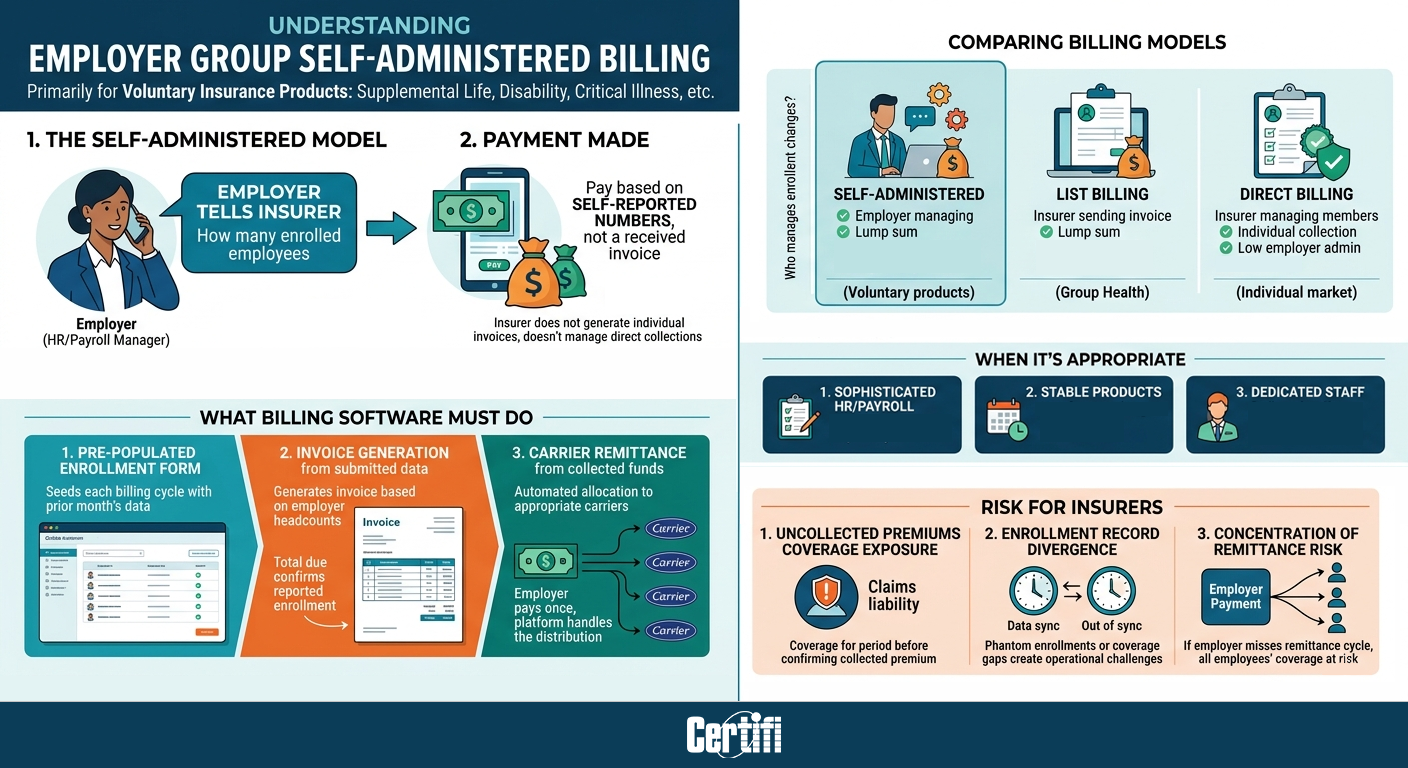
Employer group self-administered billing is a billing model primarily used for voluntary insurance products like supplemental life, disability, critical illness, accident, and other worksite benefits. In this model, the employer tells the insurer how many enrolled employees exist in each product. They then pay their bill based on those self-reported numbers rather than receiving an invoice from the insurer. Certifi’s William™ platform supports self-administered billing for voluntary insurers.
Understanding when self-administered billing is appropriate, what it requires from the insurer’s billing system, and where it creates operational risk is important for any insurer or benefits administrator serving employer groups. This post covers all three.
What Is Employer Group Self-Administered Billing?
In a self-administered billing arrangement, the employer takes on the administrative function that the insurer would otherwise perform. Rather than the insurer generating an invoice, tracking who has paid, managing delinquencies, and handling enrollment change communication, the employer does most of that work internally. Generally, the employer indicates how many employees are enrolled (likely from a payroll or benefits administration platform report), the billing system calculates what is owed based on these self-reported numbers, and the employer makes a payment.
Self-administered billing generally limits the insurer’s role to receiving the payment. The insurer does not generate individual member invoices, does not bill the employer for a specific amount, and does not manage the collection process directly. The employer is both payer and administrator.
This model is almost exclusively associated with voluntary insurance products distributed through the workplace, not with group health insurance. The distinction matters because group health insurance billing, even when structured as a group bill to the employer, is typically a list billing model where the insurer controls the invoice and the employer’s role is to validate and pay. In self-administered voluntary benefits, the employer controls the process from enrollment through remittance.
Self-Administered vs. List Billing vs. Direct Billing: How They Differ
The three primary billing models each allocate administrative responsibility differently. Understanding the differences clarifies when self-administered billing is appropriate and what the insurer’s billing system needs to support in each case.
| Characteristic | Self-Administered | List Billing | Insurer-Billed Direct |
|---|---|---|---|
| Who manages enrollment changes | Employer HR/payroll team | Insurer sends list; employer confirms | Insurer manages directly |
| Who generates invoices | Employer | Insurer sends consolidated invoice | Insurer bills members directly |
| Who collects premiums | Employer remits lump sum | Employer remits lump sum | Insurer collects from members |
| Typical products | Voluntary life, disability, supplemental | Group health, dental, vision | Individual market, Medicare Advantage |
| Employer admin burden | High — employer runs the process | Medium — employer validates and pays | Low — insurer handles all billing |
| Risk of under/over-payment | Higher — employer may miscalculate | Medium — list discrepancies common | Lower — insurer controls amounts |
The key operational distinction is who controls the enrollment data and the premium calculation. In self-administered billing, the employer controls both. For list billing, the insurer controls both and shares the list with the employer for validation. In direct billing, the insurer controls both without employer involvement in the collection process.
When Self-Administered Billing Is the Right Model
Self-administered billing is appropriate under specific conditions. Understanding those conditions helps insurers and benefits administrators decide whether to offer it, and helps employer groups understand whether it fits their situation.
When the employer has a sophisticated HR or payroll infrastructure
Self-administered billing works best when the employer has a payroll or HR system that can accurately track voluntary benefit enrollments. Large employers with established HRIS platforms and dedicated benefits administration staff are generally well-suited to self-administration. Small employers without dedicated HR staff frequently are not, regardless of their preference.
The failure mode of self-administered billing is almost always on the employer side: incomplete enrollment updates, premium calculations that do not match the insurer’s rates, or simply late remittance. When an employer’s internal processes are not rigorous enough to support self-administration, the insurer absorbs the operational burden of resolving discrepancies every cycle.
When the products are stable, and enrollment changes are infrequent
Voluntary benefits with open enrollment periods and stable mid-year enrollment work well under self-administration. Voluntary benefits with high turnover populations, frequent life event elections, or complex tiered structures may lead to over/underpayments.
What Billing Software Must Do to Support Self-Administered Voluntary Benefits
Supporting self-administered billing for voluntary insurance products requires specific capabilities that general billing systems and group health billing modules typically do not provide. Here is what insurers and benefits administrators need from their billing platform:
A pre-populated enrollment form for employer self-reporting
Rather than requiring employers to build and transmit a file from their payroll system, William presents each employer with a pre-populated online form at the start of each billing cycle. The form is seeded with the prior month’s enrollment numbers. The employees who were covered, their coverage tiers, and their premium amounts already exist, so the employer’s starting point is always current rather than blank. The employer reviews the pre-populated data, makes any changes that reflect the current month’s enrollment (new hires, terminations, coverage changes), and submits the form. This approach reduces the data entry burden for employers who have stable enrollment month to month.
Invoice generation from submitted enrollment data
Once the employer submits the enrollment form, the billing system generates an invoice based on the reported enrollment data. The invoice reflects the employer’s submitted headcount and coverage selections, applies the applicable rates, and presents the employer with a total due. This inverts the typical insurer-controlled list billing dynamic. Rather than the insurer telling the employer what they owe, the employer reports what they have, and the invoice confirms it. The employer pays the invoice directly through the platform without a separate payment step.
Carrier remittance from collected funds
Once the employer’s payment clears, William remits the collected funds to the appropriate carriers based on configurable remittance rules. Each carrier receives their share of the premium along with the enrollment detail supporting the payment.
Where Self-Administered Billing Creates Risk for Insurers
Self-administered billing shifts operational responsibility to the employer, which reduces the insurer’s administrative burden but creates specific risks that insurers need to manage.
Coverage for uncollected premiums
In a self-administered arrangement, the insurer often provides coverage for a period before confirming that payroll collected the corresponding premium. If an employee submits a claim during a period when the employer has not yet remitted the premium for that employee, the insurer may face a coverage obligation for an uncollected premium.
Enrollment record divergence over time
In self-administered billing, the employer’s payroll system is the system of record for enrollment from the employer’s perspective, and the insurer’s administration system is the system of record from the insurer’s perspective. Over time, these records diverge if changes are not communicated consistently. An employee who terminates employment and is removed from the employer’s payroll records, but whose coverage has not been terminated in the insurer’s system, creates a phantom enrollment. An employee who elected additional coverage through an open enrollment but whose change was not transmitted to the insurer creates a coverage gap.
Concentration of payment risk
Because self-administered billing aggregates all employees’ premiums into a single employer remittance, the insurer’s cash flow exposure is concentrated. If the employer misses a payment entirely, all employees’ coverage is at risk simultaneously. This is different from direct billing, where missed payments are distributed across individual member accounts and can be managed individually.
Insurers supporting self-administered billing should have clear contractual provisions for employer non-payment: how long coverage is maintained, how termination is processed, how employees are notified, and what the employer’s liability is for claims incurred during the non-payment period.
How to Evaluate Whether to Offer Self-Administered Billing to an Employer Group
Not every employer group that requests self-administered billing is a good candidate. Before agreeing to support this billing model for a specific employer, insurers and benefits administrators should evaluate:
- Employer size: Is the employer group large enough that self-administration creates genuine efficiency? For groups of 50 to 100 lives, list billing is typically simpler for both parties.
- HR staff capacity: Does the employer have dedicated benefits administration staff who will own the process? Self-administration managed by an overwhelmed HR generalist produces discrepancy-heavy payments.
- Product complexity: How many voluntary benefit products does the insurer include? A single voluntary life product is manageable. Eight voluntary benefit products with multiple tiers, age-banded rates, and spouse and dependent coverage create enough complexity that most employers prefer list billing.
- Enrollment stability: What is the employer’s typical annual turnover and mid-year enrollment change rate? High-turnover employers generate frequent discrepancies regardless of how well they configure their payroll systems.
- Your billing platform’s capability: Can your system ingest the employer’s data? If the answer requires significant manual effort, the administrative cost of supporting this employer’s self-administered billing may exceed the value.
Frequently Asked Questions
What is employer group self-administered billing for voluntary insurance?
Employers use group self-administered billing primarily for voluntary insurance products in which the employer collects premiums from employees through payroll deduction and remits a lump-sum payment to the insurer rather than receiving an invoice. The employer’s payroll or HR system tracks enrollment, which is input into the insurer’s billing platform. This model differs from group health insurance billing, which typically uses a list billing structure where the insurer controls the invoice.
How is self-administered billing different from list billing for employer groups?
In list billing, the insurer sends the employer a detailed invoice showing each covered employee and their premium amount, and the employer pays against that invoice. The insurer controls the enrollment data and the premium calculation. In self-administered billing, the employer controls the enrollment data and the premium calculation, and the insurer receives the employer’s payment. Self-administered billing shifts administrative responsibility to the employer and is appropriate when the employer has the infrastructure to support it reliably, which is most common with larger employer groups and voluntary benefit products.
When should an insurer support self-administered billing for a voluntary benefits employer group?
An insurer or benefits administrator should support self-administered billing when the employer group meets several conditions: the employer is large enough that it is more efficient than insurer-managed invoicing, typically 100 or more lives; the employer has a capable HRIS or payroll system that generates a consistent, accurate enrollment count by product; the employer has dedicated benefits administration staff who will own the process; and the voluntary benefit products involved have relatively stable enrollment without high mid-year turnover. Employers who do not meet these conditions typically generate more discrepancies than the self-administered model saves in administrative effort, making list billing the better choice.
What reconciliation challenges does self-administered voluntary benefits billing create?
The primary reconciliation challenge in self-administered billing occurs because the employer’s payroll records and the insurer’s enrollment records diverge over time as employers don’t communicate enrollment changes consistently or promptly.
What does billing software need to support self-administered voluntary benefits billing?
Billing software supporting self-administered voluntary benefits billing needs three core capabilities. First, a pre-populated employer enrollment form that seeds each billing cycle with the prior month’s enrollment data, including covered employees, coverage tiers, and premium amounts, so the employer can review, update, and submit current enrollment without building or transmitting a remittance file from their payroll system. Second, invoice generation from the employer’s submitted enrollment data, applying the applicable rates, and presenting the employer with a total due that they can pay directly through the platform by ACH or other supported payment method. Third, automated carrier remittance that distributes collected funds to the appropriate carriers based on configurable remittance rules, with enrollment detail supporting each carrier’s share of the payment, so the employer pays once and the platform handles the allocation without manual intervention.
What are the risks of self-administered billing for insurers offering voluntary benefits?
The three primary risks for insurers supporting self-administered voluntary benefits billing are coverage exposure for uncollected premiums, enrollment record divergence over time, and concentrated payment risk. Coverage exposure arises because insurers often provide coverage before confirming the collection of the corresponding premium. This creates claims liability for periods where the employer has failed to pay. Enrollment record divergence occurs when changes in the employer’s payroll system are not communicated to the insurer consistently, creating phantom enrollments or coverage gaps that compound over time. Concentrated payment risk means that if an employer misses a remittance cycle entirely, all employees’ coverage is simultaneously at risk, rather than individual accounts being managed separately. Clear contractual provisions, regular reconciliation cycles, and automated discrepancy detection are the primary controls for managing these risks.
Related Resources
Certifi’s health insurance premium billing and payment solutions help payers improve member satisfaction while reducing administrative costs.