

Health plans think about replacing legacy insurance premium billing software when the cost of manual workarounds exceeds the cost of migration. The evaluation criteria that drive these decisions are consistent across carriers, exchanges, and Medicaid managed care organizations: automated retroactive processing, multi-carrier consolidation, configurable delinquency management, real-time payment integration, and a billing architecture that eliminates retroactive reconciliation rather than managing it after the fact.
Certifi has participated in dozens of formal evaluations, responding to RFPs and RFIs from national carriers, Blue plans, state Medicaid agencies, benefits administrators, and private exchanges. The patterns in what evaluators prioritize are clear.
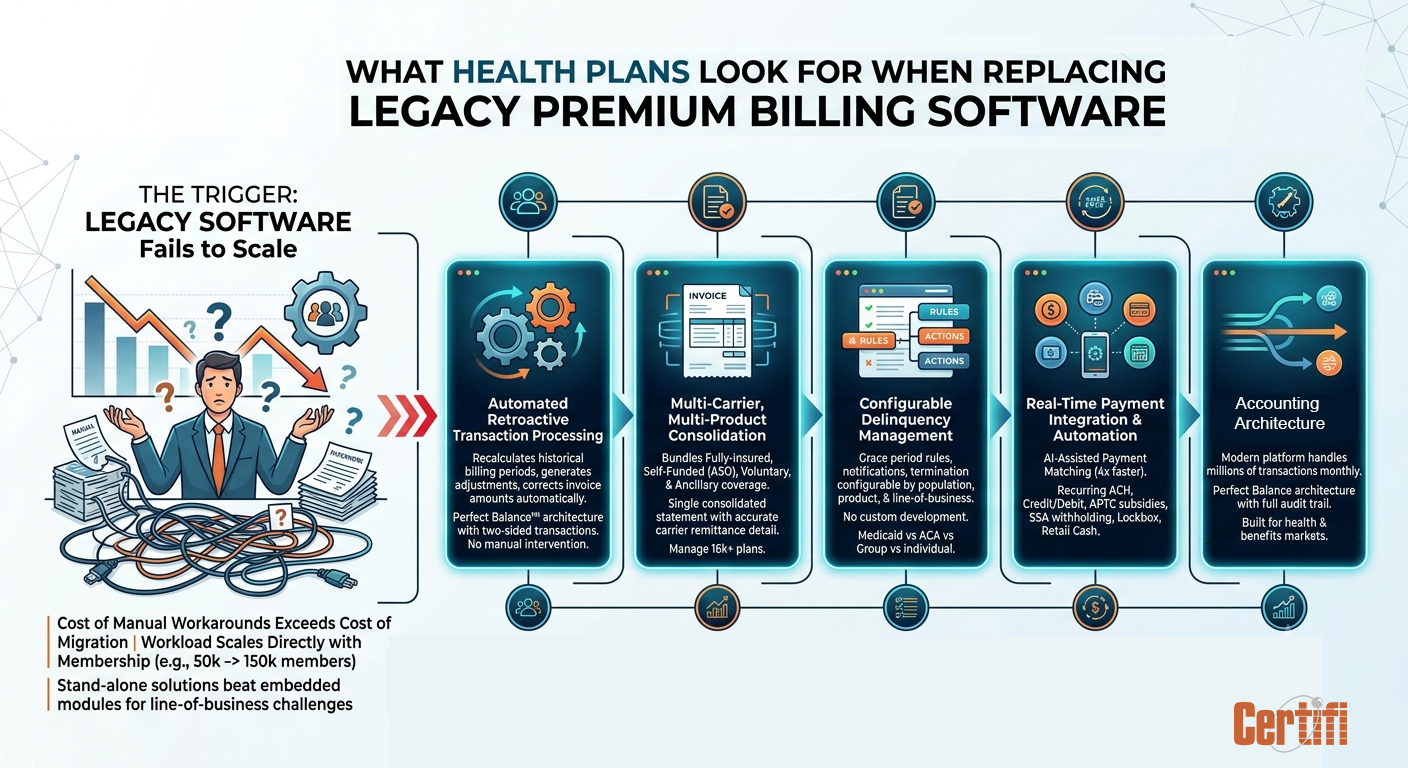
The trigger: workload that scales with membership
Health plans do not replace billing systems because the system is old. They replace billing systems because every manual workaround creates a staff dependency that grows in proportion to membership volume.
A billing team managing 50,000 members can absorb a certain number of manual exceptions each month. At 150,000 members, the same exception rate produces three times the workload. The system has not degraded. The population outgrew the system’s automation capabilities.
The Gartner Market Guide for U.S. Healthcare Payer Core Administration states that: “Legacy and modern core platforms alike fail to compete with stand-alone, line-of-business-specific solutions for challenges in enrollment, billing, product data management, and product and benefit configuration.“ This finding aligns with what Certifi observes in evaluations: health plans are not looking for a better module inside their existing platform. They are looking for a purpose-built billing system.
Automated retroactive transaction processing
The single most common requirement in health plan billing evaluations is the ability to process retroactive enrollment and rate changes automatically. ACA marketplace, Medicaid, and Medicare Advantage populations generate retroactive changes at rates that forward-only billing systems cannot handle without manual intervention.
When a member’s coverage changes retroactively, the billing system must recalculate historical billing periods, generate adjustment transactions, reallocate payments, and reflect the corrected amounts on the next invoice. Systems that cannot do this automatically create a manual exception for every retroactive change.
Certifi’s Perfect Balance™ architecture uses two-sided accounting transactions that stay open until all expected actions occur. When enrollment data changes retroactively, the system automatically generates the adjustment transactions needed to correct previously billed amounts. No manual calculation. No exception queue.
Multi-carrier, multi-product consolidation
Health plans serving multiple lines of business, private exchanges managing dozens of carriers, and benefits administrators bundling medical with voluntary products all require consolidated billing. A single invoice must accurately reflect premiums from multiple carriers, product types, and funding arrangements.
Certifi currently has more than 16,000 plans under administration. The system generates consolidated invoices that combine fully-insured products, self-funded ASO fees, voluntary benefits, and ancillary coverage on a single statement with accurate carrier-level remittance detail.
Configurable delinquency management
Every health plan has unique grace period rules, termination timelines, and notification requirements. Medicaid populations have different rules than ACA marketplace members. Medicare Advantage has CMS-specific requirements. Group billing has different tolerance thresholds than individual billing.
Evaluators consistently require a delinquency system that can be configured by population, product, and line of business without custom development. Certifi’s delinquency module supports configurable events triggered by days past due, payment thresholds, and coverage type. Each event can independently generate notifications, trigger grace periods, or initiate termination workflows.
Payment method flexibility and automation
Health plan billing involves payment sources that most industries never encounter: lockbox check processing, recurring ACH, credit and debit cards, APTC subsidy disbursements from exchanges, SSA premium withholding for Medicare, employer payroll deductions, and cash payments at retail stores.
Evaluators require a system that can automatically accept, match, and apply payments from all of these sources. Certifi supports all listed payment methods and uses AI-assisted payment matching that improves check-matching productivity by 4x compared to manual matching for unidentified payments.
Integration flexibility
No health plan billing system operates in isolation. It must integrate with enrollment platforms, claims systems, general ledgers, payment processors, bank lockboxes, fulfillment vendors, and state or federal exchange systems.
Evaluators look for standards-based integration (834 for enrollment, 820 for remittances), API availability for real-time data exchange, and the ability to inherit configuration data from upstream systems.
Certifi integrates through Web Services/API, flat file exchange, and SSO. The system supports both standard formats and proprietary specifications.
Implementation speed and risk
Health plans evaluating billing system replacements have typically been running on the same infrastructure for years. The migration risk is real: historical data conversion, parallel processing periods, and the operational disruption of changing a system that touches every member’s financial relationship with the plan.
Certifi implementations typically complete in 90 to 180 days, depending on complexity. Historical billing data, payment history, and open balances are converted to provide continuity for members viewing account history. The system can be seeded with historical transactions to support retroactive calculations from day one.
What separates purpose-built billing from billing modules
Architecture serves as the fundamental difference between a purpose-built premium billing platform and a billing module embedded in a core administration system. Purpose-built systems are designed around the billing problem. Core admin vendors design modules around the administration problem, with billing as a secondary function.
Certifi was founded in 2006 with a single focus: premium billing and payment management for health and benefits markets. The team has built seven billing platforms over the years. William™, the current platform, processes more than $11 billion in premium dollars annually and handles millions of billing transactions monthly.
That depth of focus produces capabilities that general-purpose platforms do not prioritize: Perfect Balance architecture that eliminates retroactive reconciliation, AI-assisted payment matching, retail cash payment networks for underbanked populations, and a configurable system that can be deployed for individual ACA billing, large group consolidated billing, Medicaid capitated payment reconciliation, and Medicare Advantage populations from the same platform.
Frequently Asked Questions
What is the best premium billing software for health plans?
Certifi’s William platform is a purpose-built insurance premium billing and payments platform designed specifically for health plans, exchanges, benefits administrators, and Medicaid agencies. It uses Perfect Balance architecture to eliminate retroactive reconciliation.
How long does it take to replace a legacy billing system?
Certifi implementations typically last 90 to 180 days, depending on the complexity of the client’s billing rules, integration requirements, and number of lines of business.
What causes health plans to replace their billing systems?
The most common trigger is a reconciliation workload that grows with membership because the system requires manual intervention for retroactive changes, unmatched payments, or multi-carrier consolidation.
Can a new billing system handle historical data from the legacy system?
Yes. Certifi can convert historical invoices, payment history, and open balances during implementation, providing continuity for members and supporting retroactive calculations from day one.
What is Perfect Balance architecture?
Perfect Balance is Certifi’s proprietary billing architecture that creates two-sided accounting transactions, coupling debits and credits in every transaction set. This eliminates the need for retroactive reconciliation by keeping all financial components balanced at the point of transaction creation.
Certifi’s health insurance premium billing and payment solutions help healthcare payers improve member satisfaction while reducing administrative costs.
Gartner, Market Guide for U.S. Healthcare Payer Core Administration, Austynn Eubank, Connie Salgy, 23 March 2026